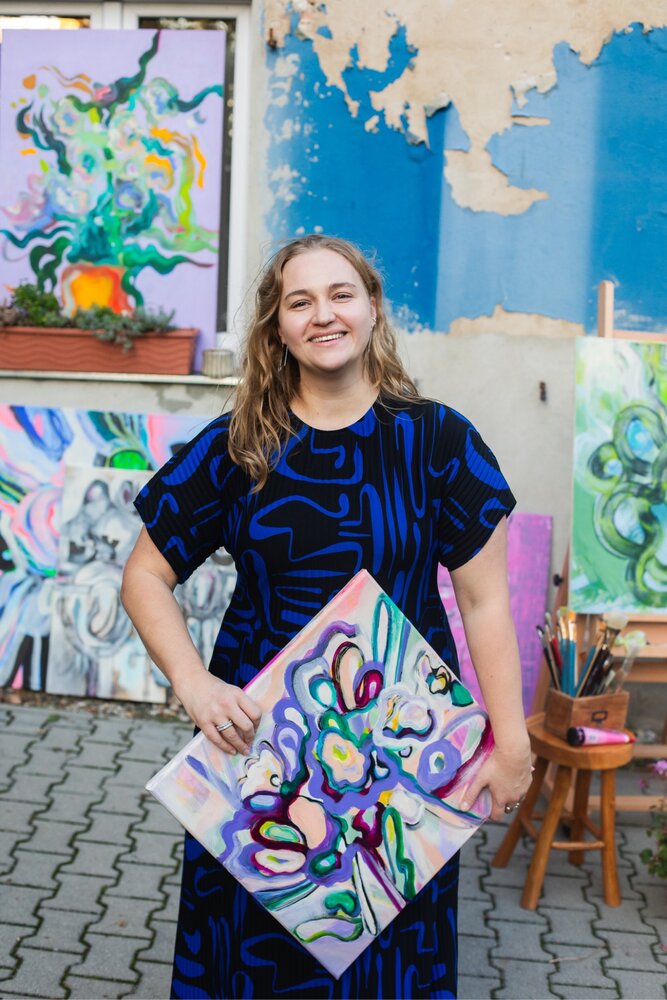
Yulia Ani is an artist whose work delves into themes of identity, belonging, and the complexities of human emotions. Using a blend of professional acrylics, oils, and inks, her paintings serve as mirrors, inviting viewers to reflect on their own experiences and emotions. This article will explore the significance of her latest series “DTR” (define the relationship).
What is your newest series?
My new series “DTR” (define the relationship). In today’s world, relationships are increasingly consumed like any other product, with dating apps and social media fostering an illusion of infinite choice. The ease of swiping through profiles, combined with the commodification of romantic connections, leads to an environment where we are quick to discard relationships at the first sign of imperfection. This mindset stems from the broader consumerist culture, which encourages constant upgrading—whether it’s technology, experiences, or even people. The gamification of dating apps encourages superficial interactions. We treat partners as disposable, focusing on instant gratification rather than meaningful connections. This culture of endless choice complicates the process of forming deep, committed relationships, as the constant availability of options can make any single connection seem less valuable. Many individuals, both men and women, are now rethinking how they approach relationships. The popularization of psychology and self-help has made people more aware of toxic patterns and unhealthy behaviors, leading to a growing number of people opting to stay single or maintain higher standards in their romantic lives. This shift reflects a deeper desire for self-awareness and emotional safety, though it sometimes results in heightened anxiety around the fear of settling or being disappointed.
I started making these big, semi-abstract paintings from that place—monster-like portraits that aren’t meant to be scary, but kind of absurd and full of emotion, even though they’re still a bit repulsive. Each painting reflects that clash between what we hope for in a relationship and what we really get. It’s about the illusions we create online and how real people rarely match up to those fantasies. These monsters capture the hidden fears and frustrations, showing how we sometimes treat people like products—just a set of traits to be dissected and analyzed. Alongside these portraits, I’ve included abstract pieces, using bold colors and energetic forms to express the emotional weight behind these experiences. They’re about desire, disappointment, and that sense of disillusionment we all face when reality doesn’t quite match our expectation.

What was or is the inspiration or concept behind this new series?
See previous answer. But more about inspiration: over the past few years, I’ve observed a growing divide between men and women highlighted in social media, online magazines, and popular culture. The rise of psychology, the impact of dating apps, and global instability have all contributed to people becoming more selective in their relationships, setting higher expectations and boundaries. A significant shift in my own life has also influenced my focus on the complexities of modern relationships. This series is both a reflection of a widespread social phenomenon and a deeply personal exploration.
What’s the message behind your new series?
The message behind my new series is an exploration of how modern relationships are shaped by the dynamics of consumer culture and digital platforms. It critiques the way dating apps and social media have commodified human connections, creating an environment where people are treated like products—easily discarded when they don’t meet our expectations.
What’s your personal highlight of the series?
A personal highlight of the series was witnessing how visitors at the exhibition connected with the artworks on a deeply emotional level. I saw a full range of reactions, from laughter to moments of deep contemplation. Several women even approached me to share how certain pieces resonated with them personally, touching on their own experiences and emotions. Seeing the art evoke such genuine responses affirmed the power of these works to not only provoke thought but also foster a sense of shared experience.
Moreover, is there a particular piece in the series that you’re most fond of? Why?
One of my favorite artworks from the series is called “Highly Personal.” It’s a large-scale piece (220 x 160 cm) composed of eight smaller canvases, all assembled into a single painting. The entire construction stands on the floor and hangs on the wall, giving it the appearance of something growing. In fact, it depicts my own relationship story spanning 15 years. Though abstract and highly expressive, even by my standards, it’s filled with personal meaning and emotion. What I particularly love about the multi-canvas format is that I can keep adding to it, allowing the story to grow and evolve, much like a tree.
If you encountered any challenges during the creation of this series, how did you manage to tackle and overcome them?
Creating the series was challenging because the topic was so personal. I wanted to maintain a balance between not revealing too many personal details while still exposing my vulnerable side when it comes to modern dating and relationships. On one hand, I researched how others relate to the topic, exploring their experiences, and on the other, I had to allow myself to be very open and honest on canvas. Finding that balance between personal expression and broader social commentary was key to tackling this challenge.
How would you recommend a visitor to experience your creation?
I would recommend visitors start by viewing the semi-abstract portraits. Then, move on to the abstract paintings, which represent the emotional responses and deeper layers behind the experience. By following this progression, viewers can first engage with the visual storytelling and then immerse themselves in the more raw, emotional aspects of the series.

What kind of engagement or interaction do you hope to have with your audience?
I hope to foster an emotional and reflective engagement with my audience. I want visitors to not only observe the artworks but to connect with them on a personal level, finding echoes of their own experiences within the pieces.
What’s next for you? Are you already working on a new series or project?
Yes, I am preparing a new body of work for my upcoming solo exhibition, which will take place from November 21st to 26th, 2024, at GlogauAir in Berlin (Glogauer Str. 16, 10999 Berlin). The series, titled “The Moment When,” explores the depth of emotions as I process my own emotional residue, which has contributed to my eating disorder, while also delving into the idea of spiritual nourishment. Unlike traditional Dutch still life paintings, which evoke tranquility, this series captures the vibrant, dynamic, and emotional turbulence of life. The artworks in this series depict abstract expressive painting on semi-abstract tables, blending vibrant emotions with structured forms to explore the complexities of human experience.
At the moment, I’m working on large-scale paintings on canvas as well as smaller sketches on paper. The final body of work will also include photographs and installations.
Conclusion
In her latest series, “DTR” (Define the Relationship), Yulia Ani explores the complexities of modern relationships. She critiques today’s consumer-driven dating culture. Her abstract paintings invite reflection on the clash between romantic idealism and reality. Yulia Ani captivates audiences by mixing personal stories with social commentary. Her work evokes a shared sense of human experience. Her art resonates globally as she continues to explore the emotional landscape of human connections. She sets the stage for her upcoming solo exhibition at GlogauAir in Berlin.