What are you currently exploring in your artistic practice that excites you the most?
At the moment, I’m interested in making my figures more abstract and moving beyond their visible form. It’s a kind of introspective process, a way of looking beneath the surface. I’m trying to capture something less tangible: the energy of nature and living beings, and the connections between them.
Is there a particular artwork on your Singulart profile that best represents your practice today? Tell us why you chose it.
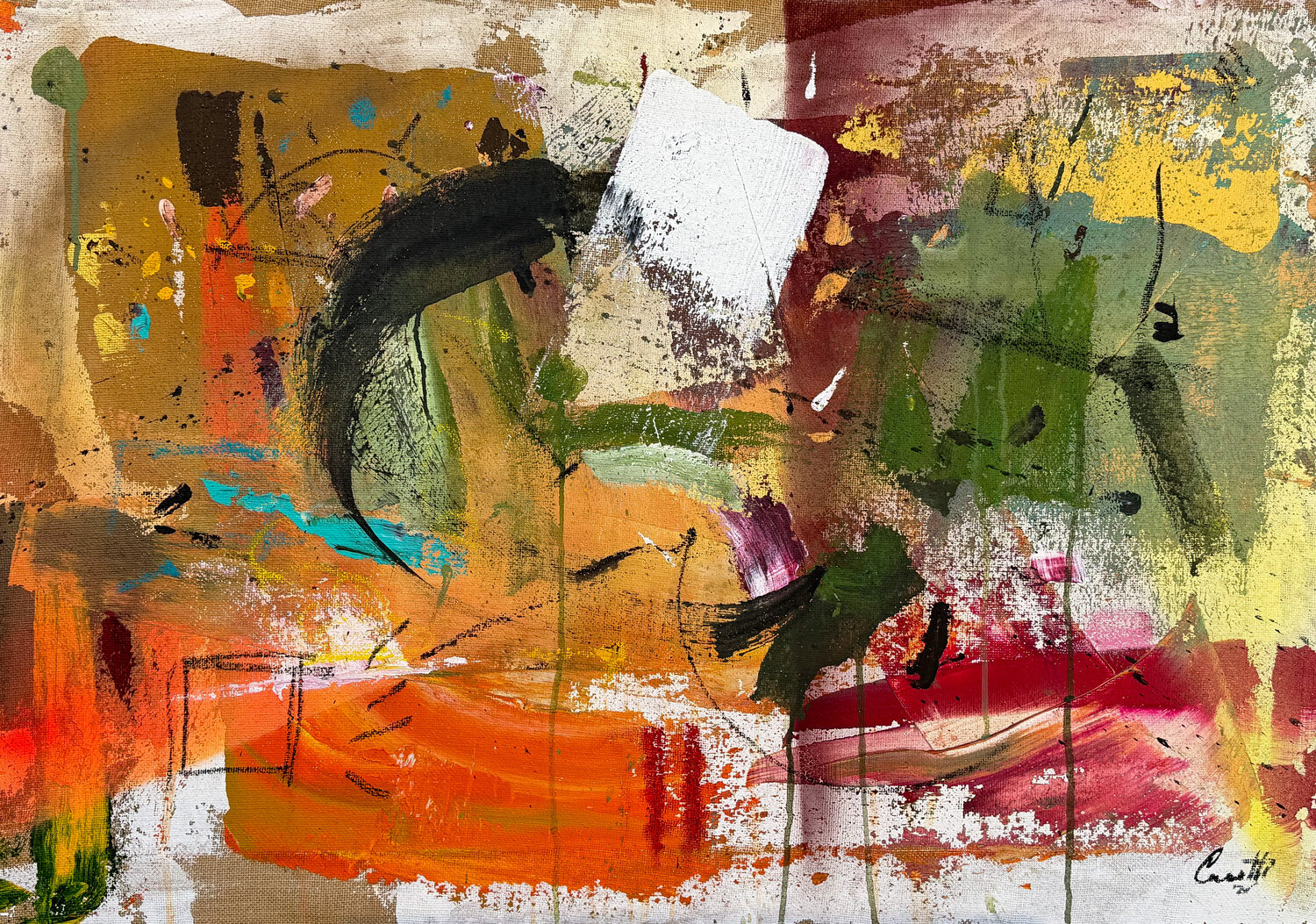
I don’t think there’s one particular artwork that represents my practice today. I would rather point to the Necessary States and Light in Motion series as a whole. Both are part of what I’m currently exploring: the boundary between figuration and abstraction and the attempt to capture something beyond visible form, whether that’s energy, movement or an inner presence.
What experiences, places or moments have had the greatest influence on the artist you are today?
I grew up around a restoration workshop, and that had a strong influence on me. I can still remember the smell of rabbit-skin glue used to prepare furniture, as well as turpentine and oil paints. Those smells immediately bring back images of my childhood.
I’ve always been fascinated by the possibility of communicating through images and using them to explore something within ourselves, then bringing it to the surface through colour, form and gesture.
Over the years, I’ve never stopped drawing, painting or working with ceramics. Gradually, this has led me to simplify and stylize the figure, looking for gesture and movement and a more instinctive way of expressing what lies beneath what we can see.
Is there a story about your artistic journey that people don’t usually know, but that has shaped who you are as an artist today?
I think childhood shapes us in ways we don’t always fully understand.
As a child, I was never someone who needed to talk constantly or always be entertained. I also grew up before social media and the internet, in a small town where there was often plenty of time to simply be bored.
Today, we tend to avoid boredom, almost as if it were something negative. But I think it can be incredibly valuable, especially for a child. It creates an empty space that imagination has to fill. When there’s nothing ready-made to entertain you, you start to invent, draw, build, imagine and create your own inner world.
Looking back, I think those quiet moments played an important role in developing my imagination. They taught me to look within myself for stimulation, and that has stayed with me throughout my artistic journey.
Are you currently working on anything you’d like people to know about?
At the moment, I’m exploring how to bring the same ideas I develop through drawing and painting into ceramics. I’ve been working with clay for several years, but recently I’ve become more and more interested in translating my visual language into three-dimensional forms, such as vessels and sculptures.
Over the past few months, I’ve been experimenting with different clays, glazes, surfaces, and firing processes, trying to understand how these materials can become part of the same research into abstraction, gesture, and energy that runs through my paintings and drawings. For me, it’s an exciting way to let the same artistic language evolve through a completely different material.
Having spent over thirty years working with the human body through tattooing, how has this intimate engagement with anatomy and skin influenced your approach to painting and sculpture?
Tattooing has taught me a lot about human nature. When someone entrusts you with their skin, especially for the kind of work I create, which is often very personal and introspective, they inevitably reveal something of themselves.
There’s a kind of confession that takes place, followed by a moment of complete trust.
After more than thirty years, that relationship with people and their bodies has influenced the way I see and interpret the world around me. The technique changes when I move from skin to canvas, paper or clay, but the thought behind the work remains essentially the same.
Tattooing is still closely connected to my painting and sculpture. It keeps me in contact with people, their experiences, emotions and vulnerabilities, and all of that finds its way into my artistic research.
Your practice moves fluidly between painting, ceramics, and tattooing, often blurring the boundaries between figuration and abstraction. How do you decide which medium or technique will best convey a particular idea or emotion?
For me, all these forms of expression are connected by a very thin line. Sometimes the work moves closer to figuration, sometimes towards abstraction, and sometimes it becomes more realistic. I don’t usually decide that in advance. I tend to follow what the work seems to require.
Even when I’m exploring deep or introspective themes, I need to enjoy the process. I need curiosity, emotion and a sense of discovery. I rarely make something simply because it has to look good or be technically well executed. I’m not interested in creating mechanically.
Whether I’m painting, working with ceramics or tattooing, I need to feel that I’m learning or discovering something. Even after so many years, I still feel the excitement I had when I began, although perhaps with a different awareness now.
The process has to give something back to me. That’s probably why I naturally move between mediums, techniques and ideas. Each one lets me approach the same inner world from a different perspective.
Living and working in Italy, with its rich artistic heritage and diverse landscapes, does your environment consciously or unconsciously find its way into your work?
Living and working in Italy inevitably has an influence on my work. It is an extraordinary country, surrounded by art, particularly classical, Renaissance, and medieval art, and it offers a constant source of discovery. Almost every small town or unexpected corner has something remarkable, whether in its landscape, architecture, history, or artistic heritage. Growing up surrounded by this richness has certainly shaped my visual sensitivity, both consciously and unconsciously.
At the same time, in recent years I have travelled and worked extensively across Italy, from Rome to Milan, Florence, and many other cities, and I sometimes feel a contrast between this incredible heritage and the energy surrounding contemporary artistic experimentation. Personally, I would love to see more space, investment, and curiosity directed toward new forms of expression and emerging artistic research.
Italy has enormous creative potential, precisely because of everything it carries from its past. I think the interesting challenge is not simply to preserve that heritage, but to allow it to become a foundation from which something new can emerge. I hope to see more of that energy developing in the future.
Imperfection and transformation are central themes in your art, where gestures, fractures, and irregularities become part of each piece’s identity. Can you share a recent work where embracing an “accident” or unexpected result led to a breakthrough in your process?
Most of my work is actually born through experimentation, so unexpected results are not really accidents for me, they are part of the process. I often return to the same materials and mediums, but I’m constantly testing their limits, combining them differently, and allowing the work to evolve in ways I hadn’t necessarily planned.
Sometimes I probably experiment too much. One of the most important things I’ve learned, especially when working with abstraction, is knowing when to stop. There is always a temptation to add something more, another gesture, another color, another reflection, because the creative energy keeps pushing you forward. But sometimes the real breakthrough is realizing that the work already contains everything it needs.
For me, experimentation is also about accepting what happens unexpectedly and learning to recognize when an imperfection, a mark, or an irregularity actually gives the work its identity. That tension between adding and removing, controlling and letting go, is one of the things I enjoy most about creating.
Your depictions of human figures and faces are often fragmented, layered, or partially erased, inviting viewers to bring their own narratives to the work. What draws you to this open-ended storytelling, and what do you hope audiences experience when encountering your art?
The figures I create are often fragmented, sketch-like, and intentionally unfinished because I want them to retain a sense of movement and energy. I like the idea that they are still being constructed, still becoming something, still moving through their own journey. They are not figures standing still or posing, they are in a constant state of transformation.
Perhaps this also reflects the way I see myself. I still feel like someone who is on a journey, still evolving, still learning, and still constructing who I am. In that sense, these unfinished figures become a reflection of something deeply human: the idea that none of us is ever truly complete.
When people encounter my work, I don’t necessarily want to tell them what they should see or feel. What matters to me is that something happens inside them. It could be a positive emotion, discomfort, curiosity, recognition, or even something they cannot immediately explain.
I believe this is one of the fundamental purposes of art, in any form: to touch something within us and make us feel. If a work creates that kind of emotional response, then for me, it has already begun a dialogue with the person looking at it.
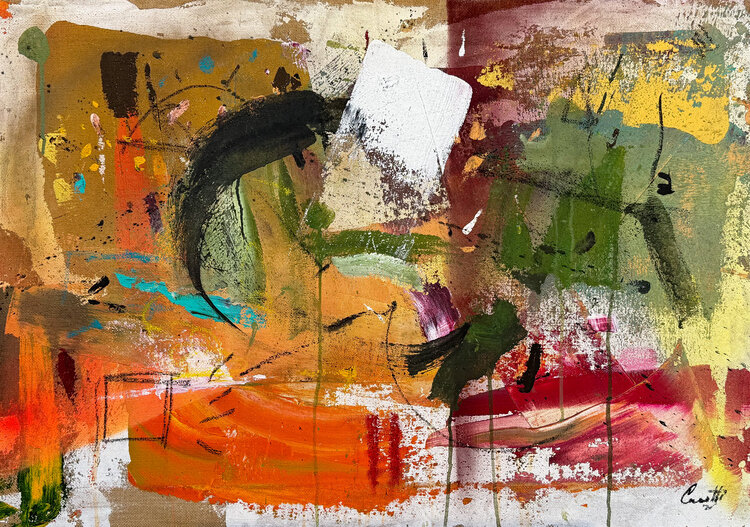 Light in motion II
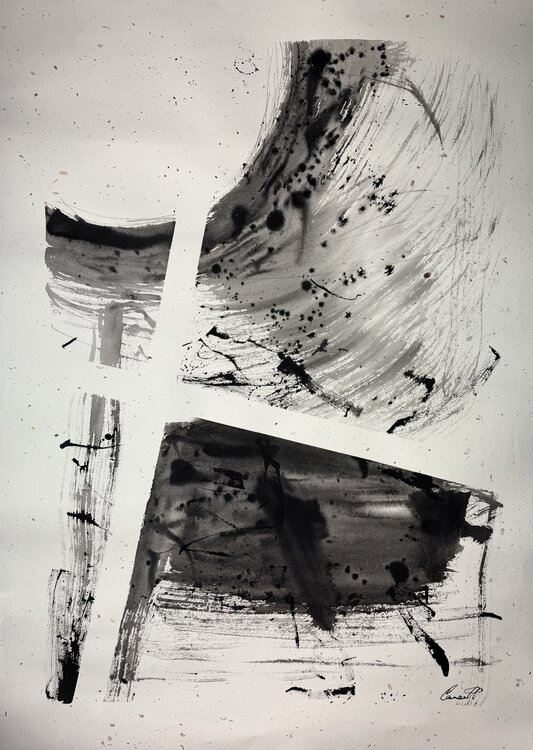 Moonlight n.2
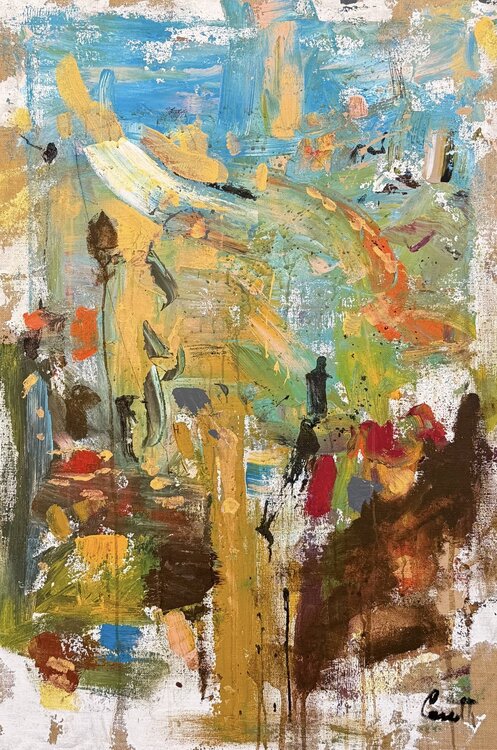 Light in motion