


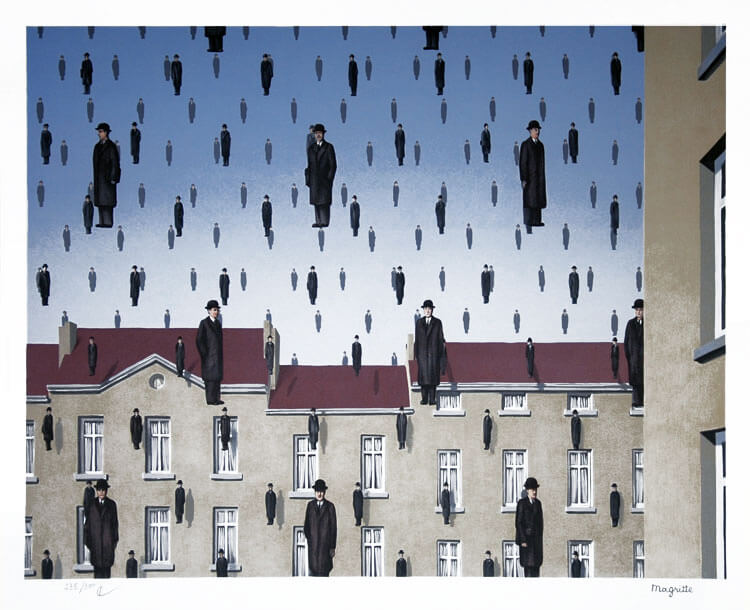
René Magritte, a Belgian artist who earned a reputation as a master of surrealism, is known for his ability to give ordinary scenes strange kinds of looks. Given the year 1898, the artistic career of Magritte covered the period when all revolutionary events appeared to be in full flight. One of his masterpieces among many is “Golconda” which, after nearly three centuries, is still able to capture and wield the eyes of the global community. In this piece, we will walk you through the life of René Magritte as an artist, the beginnings and development of his career as well as his visionary world in the picture called “Golconda”.
Who was René Magritte?
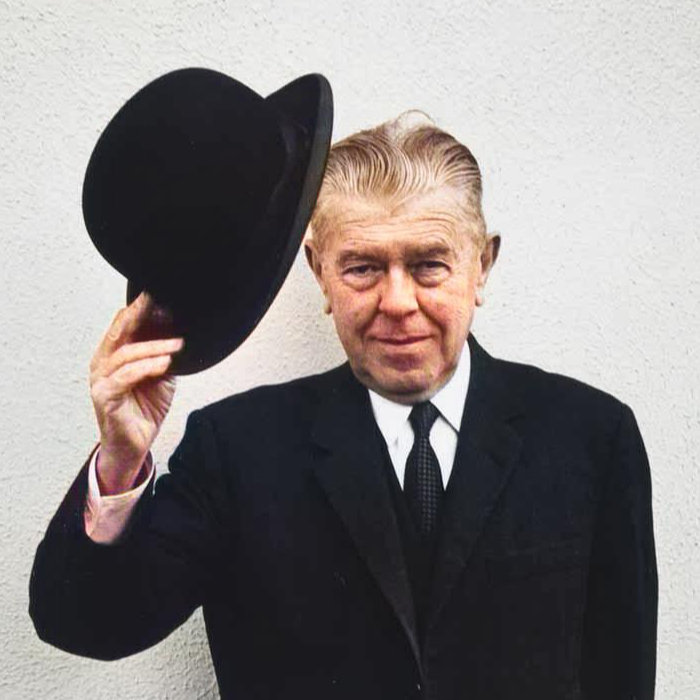
René Magritte (1898-1967) was a Belgian Surrealist painter known for his specific manner and the theme of the subconscious mind. Magritte, who was born in Lessines, Belgium, had the works of Cubism and Futurism as his early artistic inspiration. Nevertheless, it was the Surrealism led by André Breton that had the most far-reaching impact on him as an artist.
Magritte’s art frequently featured everyday objects in original situations, which questioned a viewer’s preconceived notions and invited them to consider the nature of reality. His accurate and detailed technique, as well as humorous imagery and language, led to a one-of-a-kind visual language that keeps attracting audiences even today.
FUN FACT: Despite his surrealist style, Magritte had a rather conventional day job for much of his life. He worked as a commercial artist, creating advertisements and designs for products like wallpaper and sheet music covers.
His Career
Magritte’s evolution as an artist included multiple experiments with various styles and techniques, but he is mostly associated with Surrealism and defined by his involvement in it. From the 1920s to 1930s he created some of his greatest masterpieces for example “The Treachery of Images” (1929) which includes on the picture a phrase, “Ceci n’est pas une pipe” (This is not a pipe).
In contrast to Surrealism, Magritte’s art was produced meticulously and resulted in a precise expression of his ideas. Many of his work included realistic aspects with elements of fantasy creating an atmosphere of dreamlike uncertainty that is still enjoyable to modern viewers. Learn more about the career of Magritte and other famous Belgian artists on Discovering Belgium.
What is Happening in Golconda?
| Artist | René Magritte |
| Date Created | 1953 |
| Medium | Oil on canvas |
| Genre | Surrealism |
| Period | Modern |
| Dimensions | 81 cm × 100 cm |
| Series / Versions | N/A |
| Where is it housed? | Menil Collection, Houston, Texas |
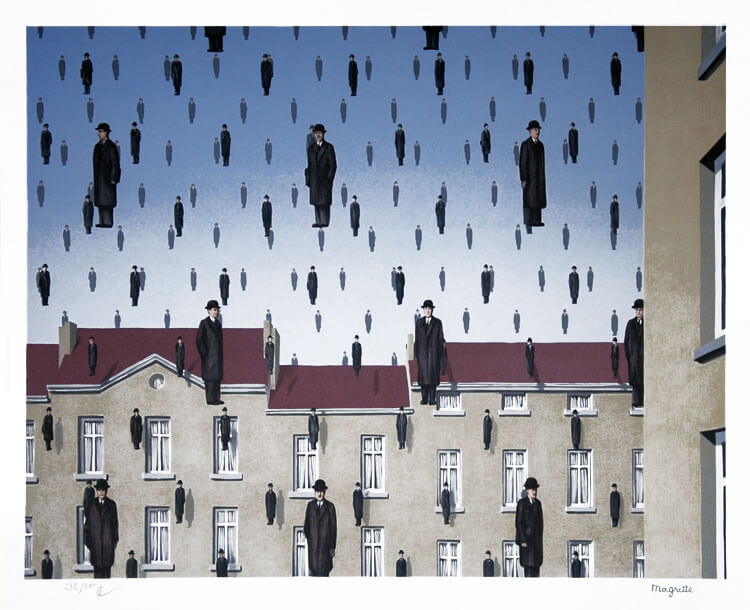
“Golconda,” completed in 1953, is Magritte’s most popular painting. It depicts surreal scenes of men in suits and bowler hats raining down from the sky amidst identical buildings. The figures on the wall are meticulously crafted, yet their descent defies logic.
Transitioning to the surreal, “Golconda” blurs reality’s boundaries. The falling men seem disconnected from reality. Magritte leaves interpretation open, inviting viewers to explore.
Interesting Facts about Golconda
Inspiration: Magritte drew inspiration for “Golconda” from a series of photographs of soldiers in World War I parachuting down. However, he transformed the scene into a surreal depiction of businessmen, reflecting his fascination with the bourgeoisie and the absurdity of societal norms.
Title: The title “Golconda” refers to a historic fort in Southern India, known for its diamond mines. By naming the painting after this location, Magritte adds another layer of intrigue, inviting viewers to contemplate the significance of wealth and materialism in the modern world.
Recurring Motif: The motif of bowler-hatted men appears frequently in Magritte’s works, symbolizing conformity and anonymity in society. In “Golconda,” the repetition of these figures emphasizes the loss of individual identity amidst a sea of uniformity.
Ambiguity: Like many of Magritte’s paintings, “Golconda” deliberately blurs the lines between reality and imagination, inviting multiple interpretations. Some see it as a commentary on the mechanization of humanity, while others view it as a critique of capitalism and consumerism.
Artwork Spotlight: La Grande Guerre
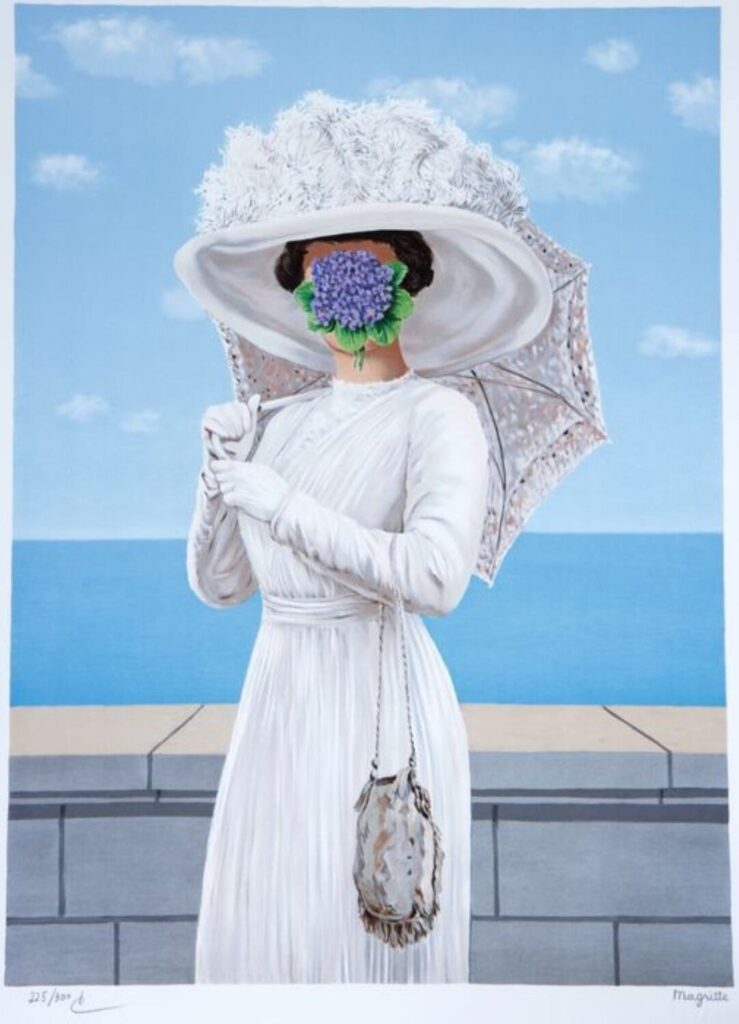
La Grande Guerre by René Magritte is available on Singulart. It is one of the most famous artworks in which a woman dressed in white, hiding her face with the bouquet, plays the role of the answer to the question. The artwork makes the audience ponder on the concept of seeing and knowing the truth that lies beneath.
Are you looking for a masterpiece from René Magritte?
Singulart presents exclusive limited edition pieces by René Magritte. To discover and acquire Magritte’s art, click on the artwork or the button below for more information!
Frequently Asked Questions
What is the meaning behind René Magritte’s paintings?
René Magritte, a Belgian surrealist painter, subverted reality in his renowned works. Commonplace items were placed in strange settings. This evoked a surreal feeling, challenging reality’s nature.
Why did René Magritte paint Time Transfixed?
During a period of exploration, Magritte created Time Transfixed. He aimed to reveal “poetic secrets” through contrasts. Challenging himself, he juxtaposed images to imply unseen objects. This approach intertwined philosophy and psychology.
Conclusion
The “Golconda” by René Magritte serves as a demonstration of what art can do to make one to re-examine and ponder on everything. The painting through the use of its surrealism and accurate details is invites the viewer on a journey into the deepest recesses of the subconscious where reality and illusion clash into a remarkable enigma. As the audience keeps pondering over the film’s meaning and significance, “Golconda” will remain a timeless masterpiece not only bound by time and space.


