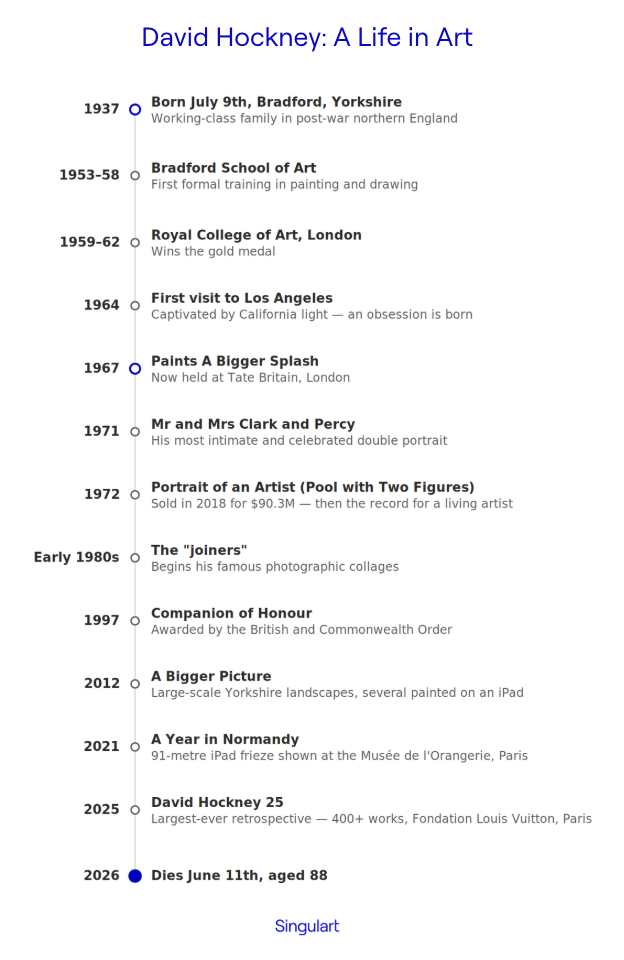
From his first pool paintings in 1960s Los Angeles to a 400-work retrospective in Paris at the age of 87, David Hockney’s career spanned seven decades and left behind one of the most significant legacies in contemporary art. Explore with us the most impactful moments in his career.
David Hockney, born in Bradford in 1937 and widely regarded as one of the most significant British artists of the 20th and 21st centuries, died on the 11h of June 2026 at the age of 88. Over a career spanning seven decades, he worked across painting, drawing, printmaking, photography, and digital media — producing some of the most recognised images in contemporary art. His death marks the end of a practice that never stood still.
From Bradford to Beverly Hills
Hockney grew up in post-war, industrial England. His father, a conscientious objector who cycled everywhere and hated advertising, was, in his son’s estimation, the person who taught him to think for himself. By eleven, Hockney had already decided he would be an artist. By the time he won the gold medal at the Royal College of Art in 1962, most of the London art world agreed.
But it was the light that changed him. In 1963, on his first trip to Los Angeles, Hockney looked down from the plane and saw the glinting grids of swimming pools and told himself he was staying. “I had spent the first 20 years of my life in the gothic gloom of the North,” he later said. “Here I felt free.”
Hockney’s Famous Artworks
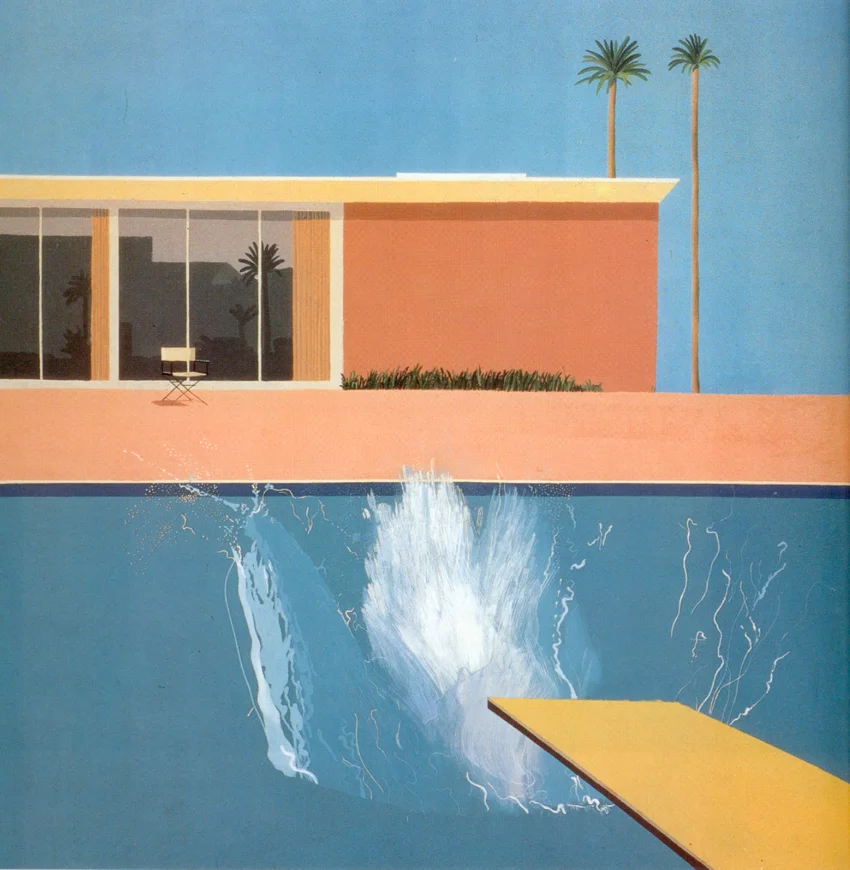
What followed were some of the most recognisable paintings of the 20th century. The California swimming pools — A Bigger Splash (1967), Peter Getting Out of Nick’s Pool (1966), Portrait of an Artist (Pool with Two Figures) (1972) — are images quite widely reproduced. A Bigger Splash alone took two weeks to complete: Hockney used small brushes to painstakingly rebuild a splash from a photograph, freezing a fraction of a second into something that has outlasted the moment by six decades. “I realise that a splash could never be seen this way in real life,” he said. “It happens too quickly.”

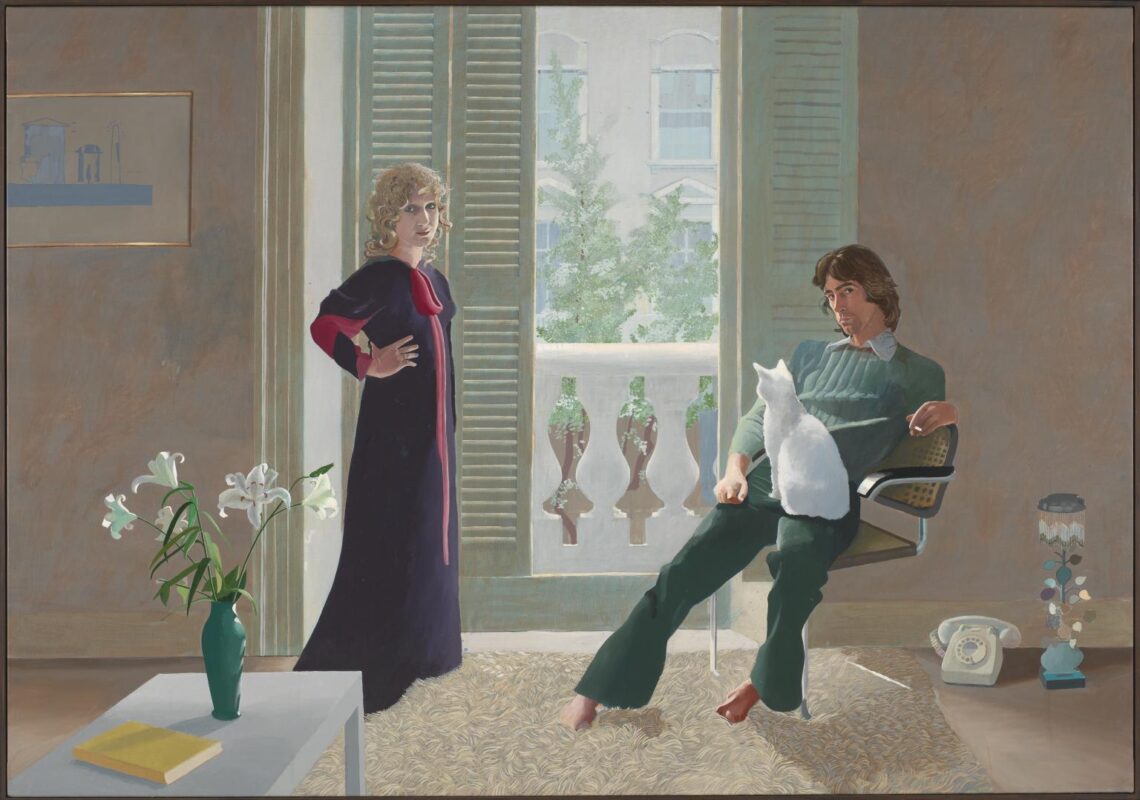
Additionally, his double portraits were a different kind of mastery. Mr and Mrs Clark and Percy (1971), which hangs in Tate Britain, shows fashion designer Ossie Clark and his wife Celia Birtwell in their Notting Hill flat. The cat, Percy, sits on Clark’s lap looking directly out at us. The painting took nearly a year to finish, and the tension in it — the distance between the two figures, the strange reversal of convention in which the man sits while the woman stands — feels as charged now as it did then.
A Practice in Constant Motion
Hockney’s evolution was a series of deliberate shifts in how he understood the act of making a picture. He began in oil, moved into etching and printmaking at the Royal College of Art — producing the Rake’s Progress series (1961–63), widely considered some of the finest prints of their generation — then abandoned oil almost entirely in California in favour of acrylic, drawn to its flatness and ability to capture hard Los Angeles light. Acrylic gave him the swimming pools.
In the 1970s and 1980s, photography became a way of questioning how we actually see, leading to the “joiners” — multiple Polaroid prints assembled into fractured, time-layered images that showed a room or a person from several angles simultaneously. Watercolour followed, well-suited to the layered greens and greys of the Yorkshire countryside. And in his final decades, the iPad became his primary medium: a new kind of canvas that allowed him to build images from light itself.
By 2011, Hockney was sending friends flower drawings he had made on his iPhone, arriving in their inboxes each morning like dispatches from a man who simply could not stop looking at the world. The A Bigger Picture exhibition (2012–2014) presented enormous Yorkshire landscapes — trees in winter, country lanes, the rhythmic repetition of hedgerows — many of them made on a tablet. One of the most striking, A Year in Normandy (2020), was a 91-metre frieze created entirely on an iPad, shown at the Musée de l’Orangerie in Paris in 2021. At 84, he was making work on a scale that younger artists might have found daunting. Each medium, for Hockney, was a question about perception.
The Legacy He Leaves
In 2025, the Fondation Louis Vuitton in Paris staged David Hockney 25, the largest retrospective of his career: over 400 works, from the early pool paintings to the iPad drawings, portraits of friends, and grand Yorkshire landscapes. Historian Simon Schama wrote of Hockney’s work that it was “admired — loved is not too strong a word — by the millions who, worldwide, flock to see it because it presupposes an expectation of pleasure.”
What he leaves behind is not just an extraordinary body of David Hockney artwork . He leaves a way of being in the world: curious, generous, stubbornly joyful. In a century that produced more than its share of darkness, Hockney kept looking at the light and finding it sufficient.

Head of Marketing at Singulart, where she has been part of the team for over five years. With seven years of experience in marketing, she brings a strategic and creative perspective to the art world. Holds a degree in Marketing from ESCP Paris. Originally from Vienna and based in Paris, she is also a practising artist with a deep passion for museums and contemporary culture.