What are you currently exploring in your artistic practice that excites you the most?
What excites me the most right now is understanding the symbols that have been present in my work for a long time. As a surrealist, I’ve collected certain elements that naturally find their way into my paintings. Over time, I’ve realized that many of them carry a personal meaning for me. Bubbles can be connected to memories, doors can represent possibilities or decisions, and there are other elements that keep returning in different ways no matter what subject or theme I am painting. I almost think of it as having my own internal dictionary. These symbols have been there for years, but I’m becoming more interested in understanding why I keep returning to them and what they say about me. I don’t always know the answer before I start painting. Sometimes I understand it through the process itself. Discovering connections between what I imagine, what I paint, and what is happening inside me is what really excites me right now.
Is there a particular artwork on your Singulart profile that best represents your practice today? Tell us why you chose it.
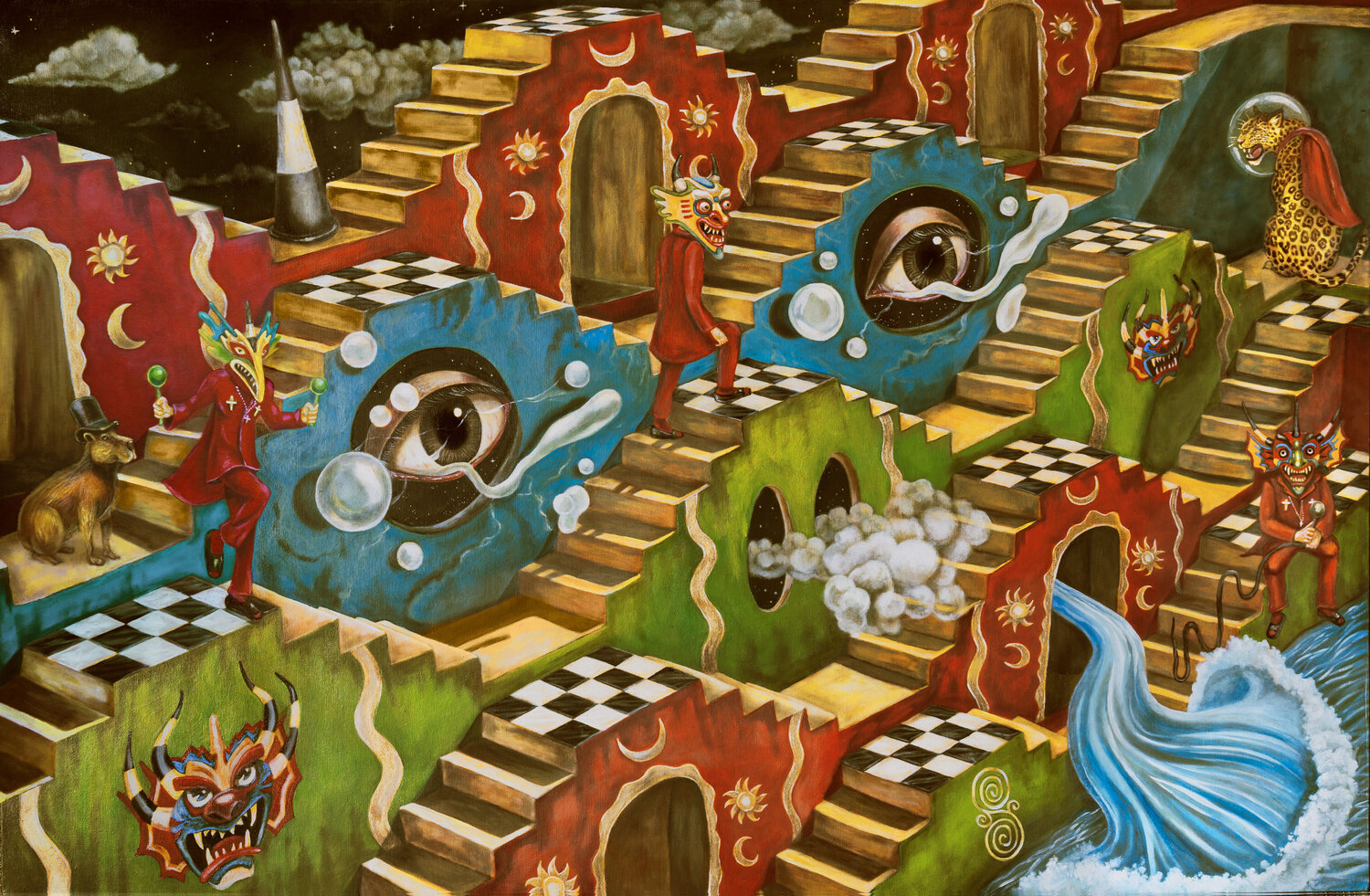
“The Land of the Devils of Yare” explores immigration through Venezuelan folklore, drawing inspiration from the Dancing Devils of Yare, a centuries-old Venezuelan tradition in which masked dancers embody devils in a ritual of faith, resistance, and transformation. Through this imagery, I explore nostalgia, identity, and the transformation that comes with leaving one’s homeland and embarking on a new journey in life, expressed through a dynamic and symbolic surrealist language.
What experiences, places or moments have had the greatest influence on the artist you are today?
I think one of the greatest influences on the artist I am today has been my journey as an immigrant—especially leaving Venezuela and experiencing life between different places and cultures. After leaving Venezuela, I had to put many of my creative disciplines on pause while adapting to a completely different life. For a while, I felt disconnected from that part of myself. Moving to Canada became an important turning point. I started finding inspiration again in a new landscape, a different culture, and in the experience of rebuilding a life from the beginning. That environment slowly brought me back to creating and helped me reconnect with myself as an artist. Barcelona has also had a huge influence on me. Studying there, being surrounded by the old masters, the architecture, and the discipline of academic painting changed the way I see and construct an image. But I think all these experiences, the memories of Venezuela, immigration, adapting to new places, and constantly transforming are what ultimately find their way into my paintings. They have changed the way I see memory, identity, nostalgia, and the idea of home.
Is there a story about your artistic journey that people don't usually know, but that has shaped who you are as an artist today?
One part of my artistic journey that people might not know is that I actually worked in digital art for many years before I seriously started painting. A few years ago, I was even planning to pursue a master’s degree in illustration. But as AI started becoming such a big part of the creative world, it made me question where I wanted to take my own practice. Instead of moving further into digital work, I felt a stronger need to explore something more tangible and reconnect with traditional art: I began to see something almost sacred in the ritual of the human hand: preparing the surface, mixing pigments, feeling the texture of the canvas, and slowly building an image through time and patience. There is something deeply human about leaving a trace of yourself physically on a surface. That eventually led me to apply to the Barcelona Academy of Art, where I’m training today. In a way, AI pushed me in the opposite direction.
Are you currently working on anything you'd like people to know about?
After my recent solo exhibition, I decided to start working on my next collection. I’m keeping the elements that have become part of my visual language, the surrealism, my palette, and many of the recurring symbols, but I’m taking them into a completely new world: THE CIRCUS. I’ve always been fascinated by the circus because there is something inherently surreal about it. It’s a place where reality and illusion coexist, where people perform different versions of themselves, and where joy, melancholy, spectacle, and mystery can exist at the same time. I’m still in the early stages, but I’m excited to see where this new world takes me.
Your early experiences in both graphic design and playing violin in a symphonic orchestra seem quite foundational to your approach as an artist; how do music and design continue to influence the way you compose and imagine your paintings today?
Graphic design and illustration taught me to become a translator. I learned how to take someone’s vision, understand what they are trying to communicate, and turn it into a visual language. That way of thinking still influences how I compose my paintings today. Playing violin in an orchestra taught me something different: discipline, patience, and the importance of feeling and projecting it. In an orchestra, you have to understand your own part, but you also have to listen to everything happening around you. I think painting is very similar in that way, every element has its own role, but everything has to work together. Music is still very present in my creative process. I often create a playlist specifically for a painting and listen to it while I work. For exhibitions, I also like curating music that complements the work and enhances the atmosphere and emotions of the pieces. So even though I’m working visually, I think music is always somewhere underneath the surface.
Living and working between Canada, Venezuela, and now studying in Barcelona, how have these different cultures and environments shaped the symbols and narratives within your surreal, dreamlike worlds?
I think living between these places has made my relationship with identity and home much more complex. Venezuela is where my memories and many of my earliest visual references come from, so there is always a sense of nostalgia and folklore that finds its way into my work. Canada gave me a different kind of perspective. As an immigrant, I had to rebuild my life there, and that experience of adapting to a new environment became part of my visual language. I started seeing home not necessarily as one physical place, but as something you carry with you. And Barcelona has opened another door for me. Being surrounded by its architecture, history, and artistic tradition, while studying classical techniques at the Academy, has influenced the way I construct my imaginary worlds. I think all three places exist together in my paintings. Sometimes they appear very clearly through symbols or references, and sometimes they are much more subtle. My surreal worlds are probably a reflection of that experience of living between realities, between where I come from, where I am, and the places I explore or imagine.
Your practice masterfully fuses academic realism with a sense of surreal wonder and symbolism; what draws you to this blend of disciplined technique and imaginative storytelling?
I think what draws me to this combination is that, in a way, surrealism has realism inside it. I want to learn how to paint reality accurately before I start playing with it. There’s something very powerful about understanding the rules before you decide to break them. I often think, “to unbuild, you first need to know how to construct.” That’s one of the reasons I’m so committed to academic training. I want to understand anatomy, light, volume, perspective, texture and all the fundamental things, so that when I distort or transform something, it’s a conscious decision rather than a limitation of my technique. For me, realism becomes the foundation, and surrealism becomes the freedom to question that reality. The more accurately I can construct a world, the more interesting it becomes to alter it, bend it, or create something impossible within it. That tension between discipline and imagination is really at the heart of my work.
Artists like Dalí, Magritte, Remedios Varo, and Leonora Carrington have inspired your visual language—how do you reinterpret their influence to express your own vision of identity, memory, and the subconscious?
I think what I take from these artists is not so much their specific imagery, but their permission to look at reality differently. All these surrealist masters created worlds where the familiar could become strange, and where symbolism could open a door into something deeper. But I’m interested in taking that idea and making it personal. My own surrealism comes from my experiences, my memories, my Venezuelan background, immigration, and the things I carry with me. That’s where my own symbols begin to develop. So rather than trying to imitate the surrealists who inspired me, I’m using what they taught me as a foundation to explore my own subconscious, my identity, and the way memory transforms reality.
When you invite viewers to find their own meaning in your work, what are you hoping they experience or discover as they step into the tangible yet impossible realities you create?
I think people will always project a part of themselves onto what they see, and that’s exactly what I hope for. Once a painting leaves my studio and goes out into the world, it isn’t completely mine anymore. I won’t always be there to explain where every symbol came from or what I was thinking when I painted it. I want people to be able to use the painting almost as a mirror, to see something of themselves in it and give it a meaning based on their own memories, experiences, and emotions. For me, the painting can have a very personal origin, but its meaning doesn’t have to remain personal. If someone can connect with it, enter the impossible world I’ve created, and find something of their own within it, then I feel the painting has truly come alive and accomplished its purpose.
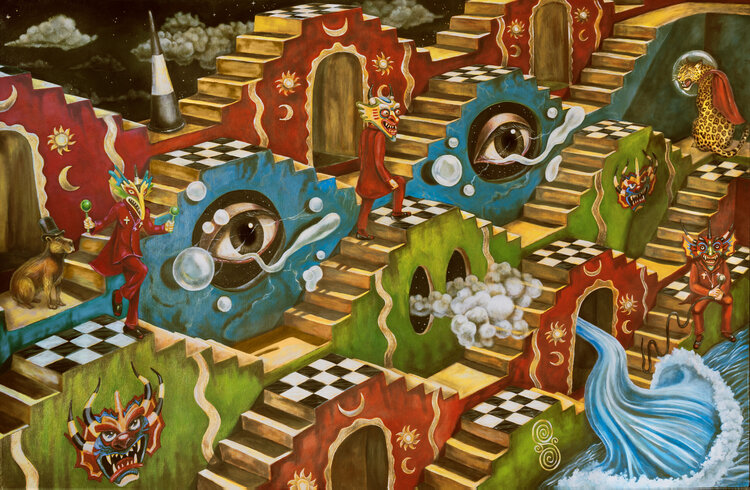 The Land of the Devils of Yare
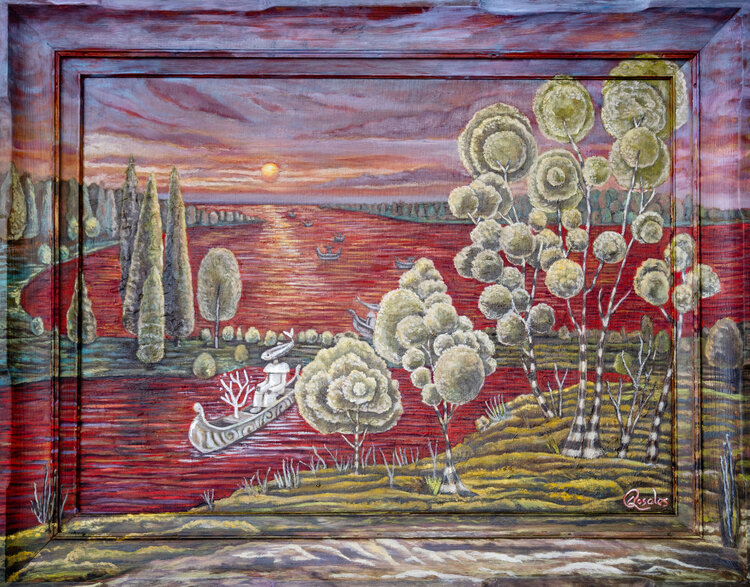 Beyond the Edge
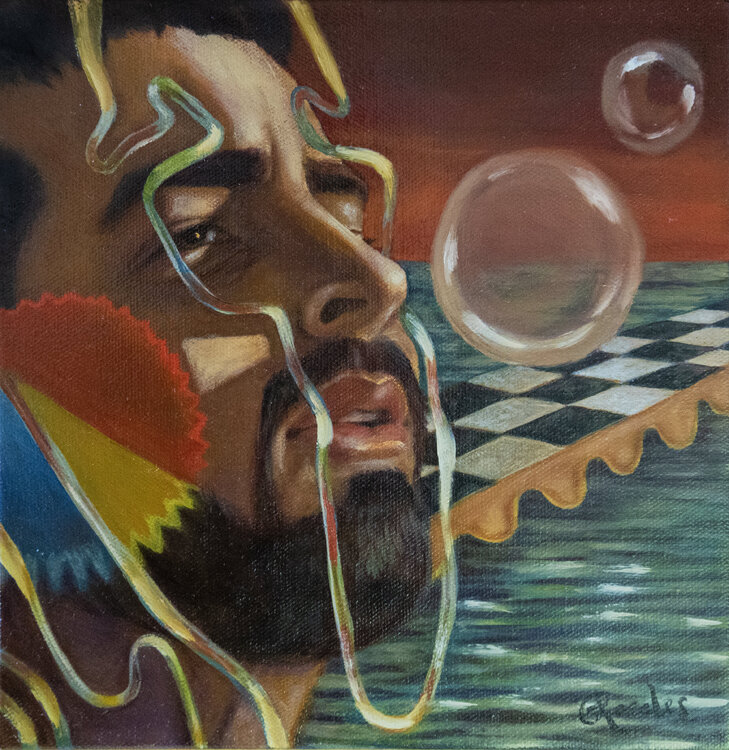 Somewhere in Between