What are you currently exploring in your artistic practice that excites you the most?
Many painters tend to work with tight brushstrokes because giving the brush freedom and surrendering some control to it requires great self-confidence and courage. These days, I find myself working with loose brushstrokes, allowing my brush to break free and move more spontaneously across the canvas. I am learning to trust the process, embrace the unexpected, and let the brush express what I feel rather than dictate what I should paint. Liberating my brush is liberating a part of myself. And that is truly exciting!
Is there a particular artwork on your Singulart profile that best represents your practice today? Tell us why you chose it.
To be honest, many of my paintings fully reflect my artistic style. However, if I had to pinpoint a couple of examples, 'Pink Umbrella' and 'Selfie' truly embody who I am. These are semi-abstract pieces characterized by loose brush strokes. They explore various human emotions and moods, much like life itself, capturing moments that are sometimes hopeful and optimistic, and at other times, depressive and introverted.
What experiences, places or moments have had the greatest influence on the artist you are today?
My artistic talent was first discovered by my art teacher in middle school. At that time, I didn’t even know what oil painting was. Yet, my teacher encouraged me to buy paints, brushes, and a canvas. He gave me a photograph of a full-length female portrait and simply said, “You can do this.” He taught me only a few basic techniques and then left me to discover the rest on my own. I completed the painting, and even I couldn’t believe the result. It had turned out beautifully! My teacher was so impressed that he submitted it to an exhibition, where it was sold.
Is there a story about your artistic journey that people don't usually know, but that has shaped who you are as an artist today?
After retiring from teaching due to my disability, I found myself thinking about the days when I used to paint with oils. I began to wonder whether I could still paint, even if I could no longer raise my arms or properly use my hands. Could I find a way to return to something I had always loved, despite the changes in my body? I decided to be brave. I bought paints, brushes, and canvases, and I began again.
Are you currently working on anything you'd like people to know about?
I am currently working toward developing a more semi-abstract style through the use of loose brushstrokes. Rather than controlling every detail, I want to give my brush greater freedom and allow the painting to evolve more spontaneously. This approach requires me to trust my instincts, embrace uncertainty, and accept that beauty can emerge from what is imperfect, unexpected, or unfinished.
You describe painting as your language, especially after being diagnosed with ALS—how has your relationship with your art changed since it became your main way of expressing what words cannot say?
I didn’t know exactly how I would manage, or whether it would even be possible. But something inside me refused to give up on painting. I was determined to find my own way, to adapt, and to let my creativity live on. That decision marked the beginning of a new chapter in my artistic journey, one in which painting became not only a form of expression, but also a way of rediscovering myself.
Despite the physical challenges you face, each brushstroke in your oil paintings is intentional and patient—can you walk us through your creative process and how you adapt it to your unique situation?
Until a year ago, I was still able to stand on my own. However, as I began to experience balance difficulties, I had to find a new way to continue painting. Today, I paint while standing with the support of a patient lift. Since I can no longer raise my arms, I have had to adapt my technique once again, holding the brush by bringing both hands together and finding a way to keep creating despite these physical limitations. And then, there is my beloved son, who makes so much of this possible. He squeezes the paint onto my palette, helps position me in the lift, and adjusts the easel up and down whenever I need it. His support has become an essential part of my artistic journey. Painting has never been just an activity for me; it is a part of who I am. Even as my body changes, my desire to create remains alive. With my son's loving support and my determination, I continue to find ways to express myself through colors, brushstrokes, and emotions.
Your work explores resilience, memory, and the connection between humanity and nature, often featuring rivers, forests, and figures—what draws you to these motifs as metaphors for endurance and hope?
Living with a disability changes your entire life, even more so when it is a progressive, incurable, and terminal illness. I used to be someone who loved traveling, being in nature, and connecting deeply with others. When I transformed into someone confined to the house and unable to communicate verbally, I began to live all those lost experiences through my paintings.
You mention a love for playing with colors and the interplay of light and shadow—how do you decide on your palettes, and what emotions or narratives are you hoping the viewer experiences through your choices?
My choice of colors is built around contrasts, much like the contrast between light and shadow. I have come to realize that the world itself is shaped by opposites, and that these opposites need one another to be seen, understood, and truly appreciated. This understanding is something I strive to reflect in my paintings. Through my art, I want people to stop seeing opposites as something negative or conflicting. Instead, I hope they will recognize that differences are not meant to divide us, but to complete one another. I believe that accepting what seems opposite to us is essential to finding a healthy balance, both within ourselves and in the world around us. For me, harmony does not mean the absence of contrasts. It means learning to embrace them.
Living in Türkiye, how does your environment or cultural background influence the atmospheres, themes, or imagery in your paintings?
People seem to have forgotten the beauty of color in my country. Whether it comes to interior decoration or clothing, many people tend to choose neutral tones, avoiding vibrant and expressive colors. This has had the opposite effect on me, inspiring me to embrace bold, vivid colors with strong personalities in my paintings. I want my colors to speak, to awaken emotions, and to remind people of the beauty and energy that color brings into our lives. When it comes to the themes I choose, I especially love expressing the labor, strength, and beauty of women. I want to honor their resilience, their quiet courage, and the countless ways they contribute to life. Through my paintings, I hope to make women's strength visible, celebrate their beauty beyond appearances, and give a voice to the emotions and stories that often go unnoticed.
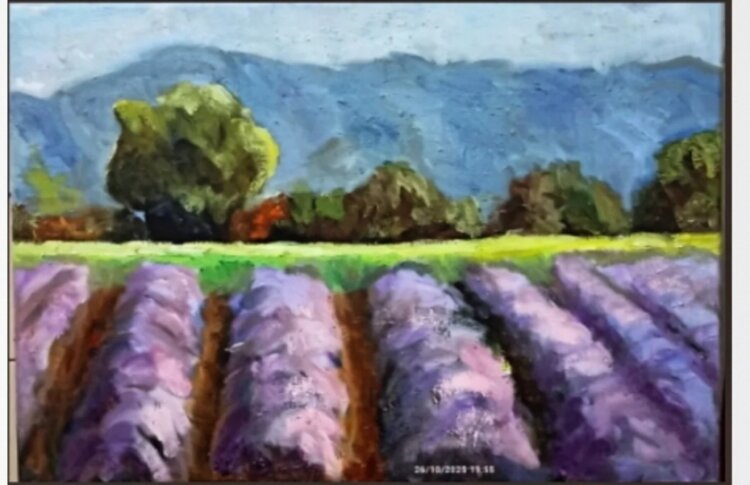 Lavender Fields
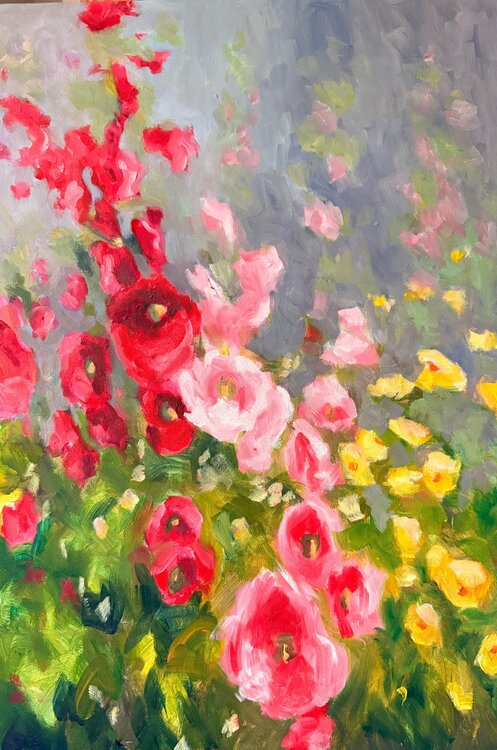 Hollyhocks
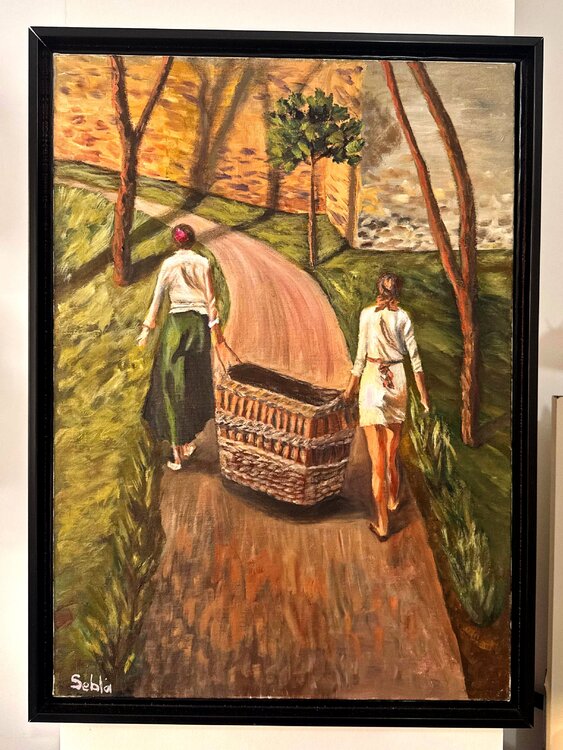 Journey of Silent Strength