

- Professional worldwide delivery, monitored by our logistics experts
- Shipping fees, duties and taxes are included in the price
- 30-day free returns (except made-to-order items)
Singulart guarantees reliability and traceability.
All the artists on the platform have been specially selected and certify to only sell works, of which they are the artist. Whatever the medium, the work is sent to the buyer with a certificate of authenticity. Photographs are numbered and signed.
Every customer can be given a copy of their certificate of authenticity by contacting support@singulart.com
With Singulart, you can pay safely by credit card or bank transfer.
For all transactions exceeding your credit limit, contact us. We are required to verify every transfer, as part of the fight against fraud and money laundering.
Singulart prices include:
- Price of an artwork defined by an artist.
- Insurance. Your order is 100% protected in case of any damage or loss.
- All customs fees, taxes, and document preparation.
- Third-party logistic provider shipping costs.
- A dedicated Singulart customer care specialist that will assist you with any questions or problems during shipment.

Cristina Fuentes
Argentina
Related collection
Exhibition LIMINAL - Cristina Fuentes
11 pieces
Artist highlights
- International Exposure
- Experienced Artist
- Featured in gallery curations
- Works on commission
Discover the creation in interiors
Artwork details
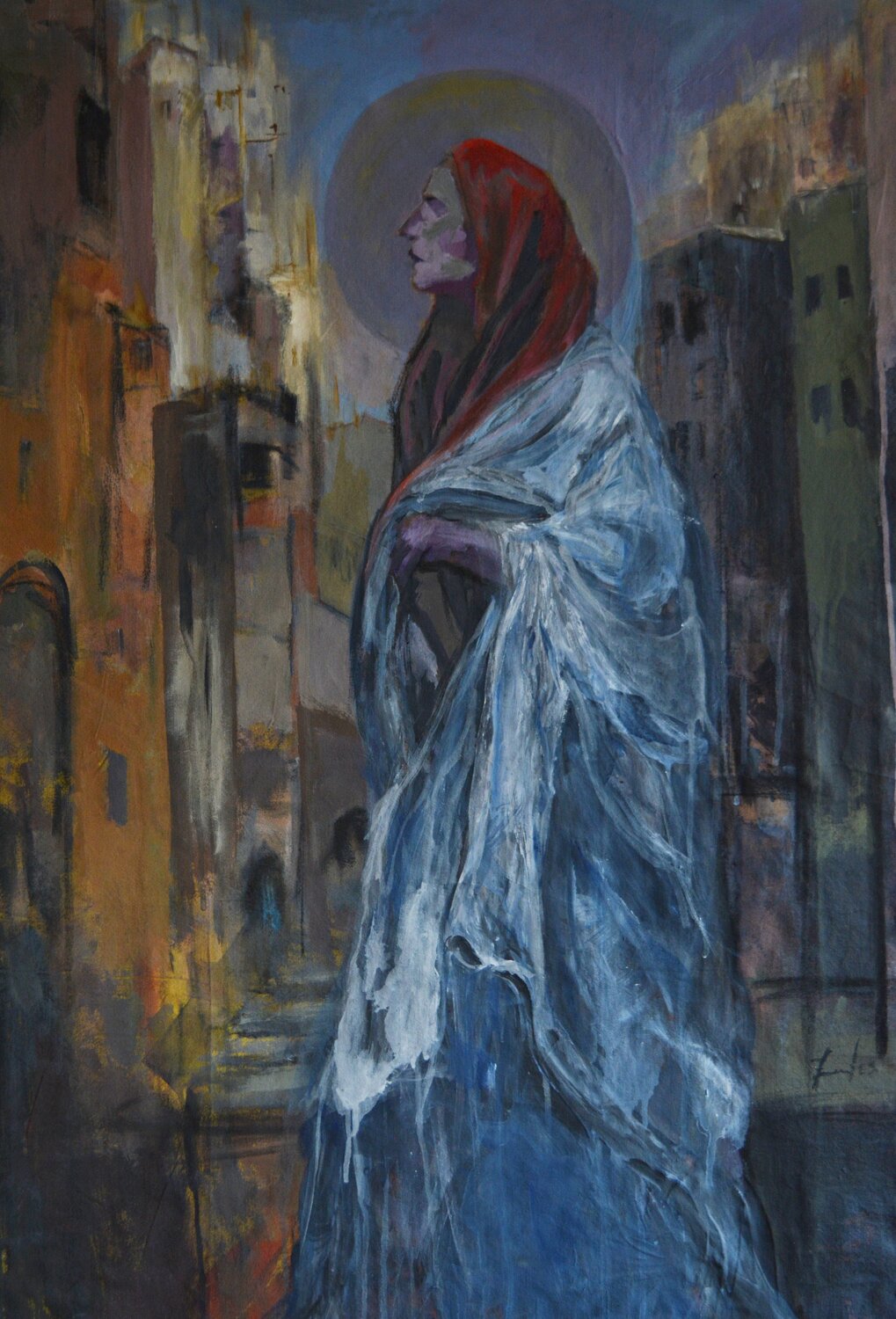
- Medium : Acrylic, Graphite on Canvas
- Other details : Artwork on supported wooden frame. Ready to hang. Framing on request.
- Dimensions : 39.4x27.6in
About this artwork
The exploration of the sacred presents a feminine figure who embodies the divine not as a fixed or absolute state, but as a transient experience. The work situates the sacred in an unstable territory, where spirituality does not manifest as full revelation, but as a silent passage through ruins, memory, and persistence.
The cloaked woman moves through a decayed landscape, becoming one with it: her body doesn't impose itself on the environment, but… rather passes through it. The cloak—both protective and fragile—acts as a visual and symbolic threshold: it covers, reveals, and dissolves, marking the boundary between the visible and the intangible. The dripping paint and the transparencies reinforce this liminal condition, where the figure seems to exist between what once was and what still endures.
The cloaked woman moves through a decayed landscape, becoming one with it: her body doesn't impose itself on the environment, but… rather passes through it. The cloak—both protective and fragile—acts as a visual and symbolic threshold: it covers, reveals, and dissolves, marking the boundary between the visible and the intangible. The dripping paint and the transparencies reinforce this liminal condition, where the figure seems to exist between what once was and what still endures.
Cristina Fuentes
Argentina
Credentials
- International Exposure
- Experienced Artist
- Featured in gallery curations
- Works on commission
« I feel the need to see what is on the other side of things, the eternal search to know that there is something beyond what we can perceive. »
Cris Fuentes is a visual artist specializing in painting, based in Argentina, whose works have been widely exhibited nationally, as well as in Italy, Nepal, Ecuador, Denmark, Mexico, Chile, and Brazil. She describes her art as based on action painting, which has converged with expressionism, in which figuration and abstraction complement each other, "blurring a possible boundary between one language and another." A nostalgia for absences and a sense that art is about filling a void have always been present in her works. Her artistic need could not be expressed in any other way than through gestures, with the power of a brushstroke. The figure of the ruin, from a material and conceptual perspective, has appealed to her as a representation of vestiges. Interestingly, ruins constitute metaphors for what interests her as an artist: inner states and the act of immersing oneself within only to re-emerge.