Not currently available for saleThis piece is currently reserved (either by a client or for an exhibition...).Get notified when it becomes available again.
Thank you very much for your interest!
Your message has been sent successfully! We will get back to you if the artwork becomes available again.
Singulart guarantees reliability and traceability.
All the artists on the platform have been specially selected and certify to only sell works, of which they are the artist. Whatever the medium, the work is sent to the buyer with a certificate of authenticity. Photographs are numbered and signed.
Every customer can be given a copy of their certificate of authenticity by contacting support@singulart.com
With Singulart, you can pay safely by credit card or bank transfer.
For all transactions exceeding your credit limit, contact us. We are required to verify every transfer, as part of the fight against fraud and money laundering.
Singulart prices include:
Price of an artwork defined by an artist.
Insurance. Your order is 100% protected in case of any damage or loss.
All customs fees, taxes, and document preparation.
Third-party logistic provider shipping costs.
A dedicated Singulart customer care specialist that will assist you with any questions or problems during shipment.
Other details :
Artwork on fixed support. Artwork framed.
Dimensions :
20.1x14.2in
About this artwork
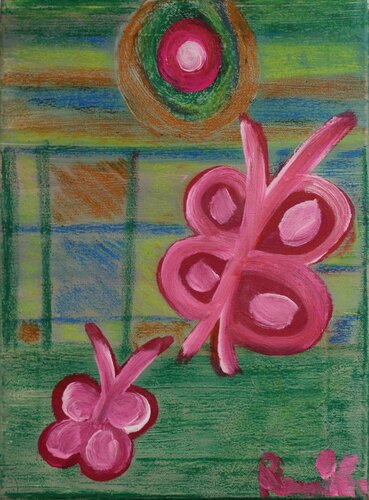
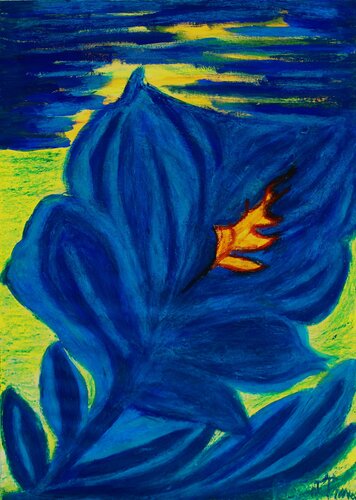
In this work, I wanted to capture the fleeting nature of dandelions blown by the wind over a vibrant landscape of contrasting colors. The oil pastel technique allowed me to express intense emotions and dynamism, creating a sense of hope and lightness. Imagining it in your home will bring positive energy and an invitation to enjoy life's fleeting moments.
Romina Petrini's Art Pedagogy is a profound integration of academic excellence and militant ethics, inspired by Janusz Korczak. Her approach transforms painting into a manifesto that places the sacredness and rights of children at its core. The roots of his art lie in the teachings of two great masters: Patrizio Moscardelli, from whom he learned the use of material and strong lines as languages of resistance and memory; and Cesare D'Antonio, who shaped his sensitivity to "beauty," understood as a universal ethical value and not an aesthetic goal. Petrini's is a pedagogy of active memory: the paintbrush becomes an instrument of justice to give childhood a voice, placing the child back at the center of the cosmos as a free and immortal being.