Not currently available for saleThis piece is currently reserved (either by a client or for an exhibition...).Get notified when it becomes available again.
Thank you very much for your interest!
Your message has been sent successfully! We will get back to you if the artwork becomes available again.
Singulart guarantees reliability and traceability.
All the artists on the platform have been specially selected and certify to only sell works, of which they are the artist. Whatever the medium, the work is sent to the buyer with a certificate of authenticity. Photographs are numbered and signed.
Every customer can be given a copy of their certificate of authenticity by contacting support@singulart.com
With Singulart, you can pay safely by credit card or bank transfer.
For all transactions exceeding your credit limit, contact us. We are required to verify every transfer, as part of the fight against fraud and money laundering.
Singulart prices include:
Price of an artwork defined by an artist.
Insurance. Your order is 100% protected in case of any damage or loss.
All customs fees, taxes, and document preparation.
Third-party logistic provider shipping costs.
A dedicated Singulart customer care specialist that will assist you with any questions or problems during shipment.
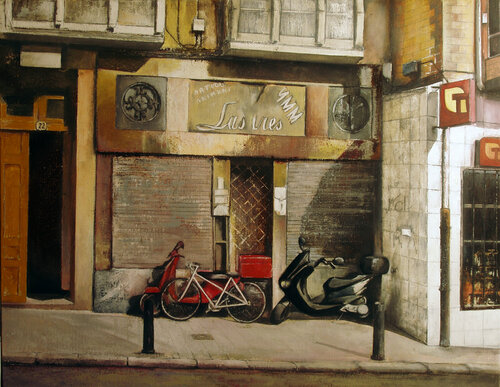
New work that the artist adds to this series dedicated to the poet Lorca during his stay in New York in 1930, for the composition of this work he took black and white photographs as a model to which he has added a car of the time in the foreground. It is part of a series painted for the illustration of a new book dedicated to Lorca in New York.
García Lorca left Spain in 1929 to give lectures in Cuba and New York. Even so, the reason for the trip… was perhaps a pretext to change the scene and flee from the environment that surrounded him and that oppressed him: due to a sentimental failure and the inner dilemma he felt due to his sexuality, Lorca suffered a deep depression at that time. . He lived in New York from June 25, 1929 to March 4, 1930, then leaving for Cuba, where he lived for three months.
His work shows a mixture of realistic and impressionist styles, both awakening a great interest in the current art market. Realism attracts collectors who appreciate precise technique and detailed representation, as seen in his works of urban landscapes and still lifes. The impressionistic elements, evident in his depictions of people in environments atmospheric, they are very popular with audiences interested in emotional and expressive techniques.