

- Professional worldwide delivery, monitored by our logistics experts
- Shipping fees, duties and taxes are included in the price
- 30-day free returns (except made-to-order items)
Singulart guarantees reliability and traceability.
All the artists on the platform have been specially selected and certify to only sell works, of which they are the artist. Whatever the medium, the work is sent to the buyer with a certificate of authenticity. Photographs are numbered and signed.
Every customer can be given a copy of their certificate of authenticity by contacting support@singulart.com
With Singulart, you can pay safely by credit card or bank transfer.
For all transactions exceeding your credit limit, contact us. We are required to verify every transfer, as part of the fight against fraud and money laundering.
Singulart prices include:
- Price of an artwork defined by an artist.
- Insurance. Your order is 100% protected in case of any damage or loss.
- All customs fees, taxes, and document preparation.
- Third-party logistic provider shipping costs.
- A dedicated Singulart customer care specialist that will assist you with any questions or problems during shipment.

Adele The Princess
France
Discover the creation in interiors
Artwork details
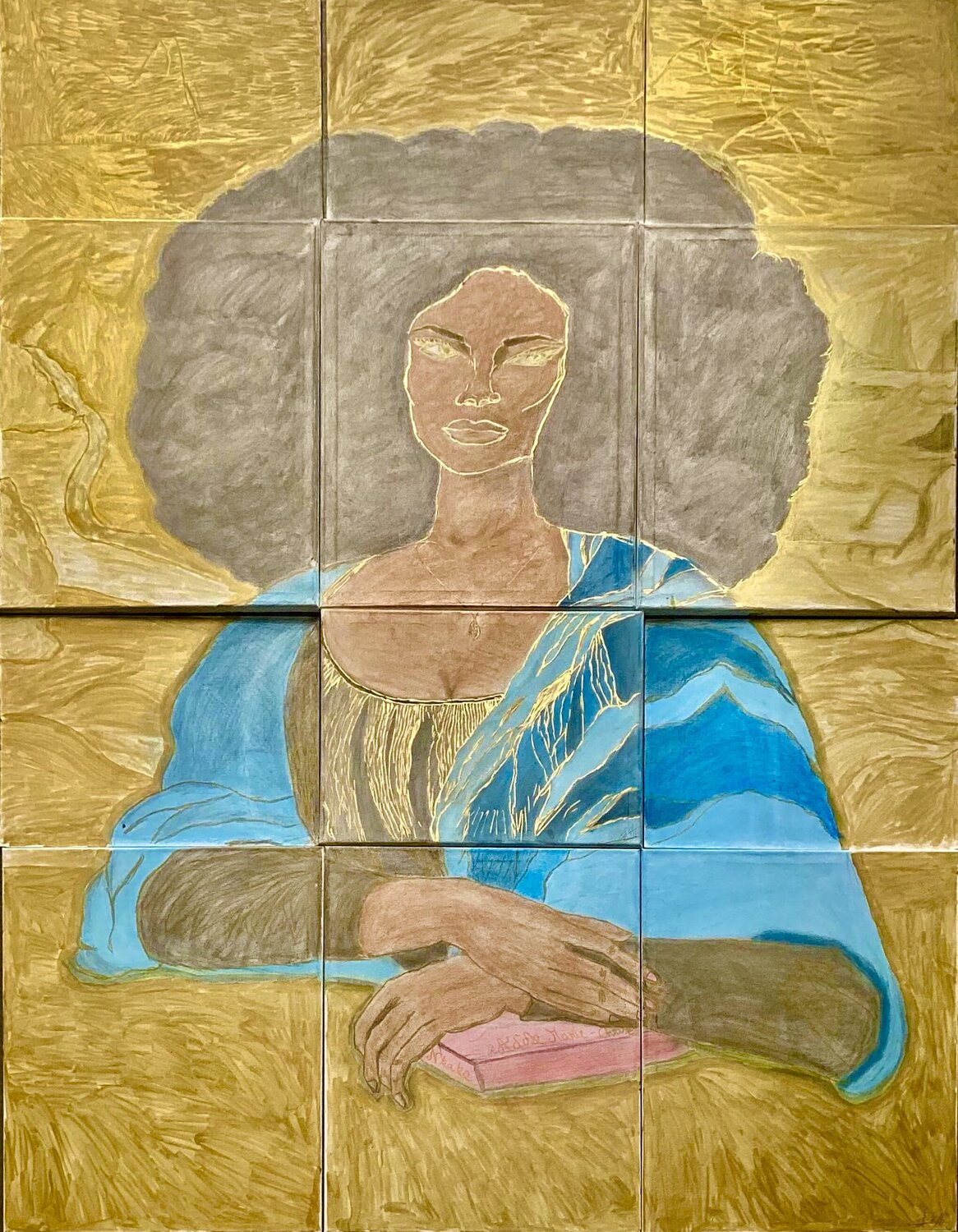
- Medium : Pastel, Pencil on Canvas
- Other details : Unmounted artwork. Mounting and/or framing available on request.
- Dimensions : 63x47.6in
About this artwork
Originally conceived as a single painting, Kalla Emma Lisa evolved into a twelve-panel composition following a miscalculation in canvas dimensions. This unexpected structure creates a subtle depth, guiding the viewer’s gaze toward the center.
The title merges the names of my sisters, Kalla and Emma, with “Lisa,” referencing the Mona Lisa. In this reinterpretation, a Black woman takes center stage, reclaiming a space historically underrepresented… in classical art.
Part of a broader vision, this work belongs to a personal “Louvre” dedicated exclusively to Black figures, with Kalla Emma Lisa as a central piece. After restoration, the artwork mysteriously disappeared, echoing the Mona Lisa theft, and is imagined as a future rediscovery.
The title merges the names of my sisters, Kalla and Emma, with “Lisa,” referencing the Mona Lisa. In this reinterpretation, a Black woman takes center stage, reclaiming a space historically underrepresented… in classical art.
Part of a broader vision, this work belongs to a personal “Louvre” dedicated exclusively to Black figures, with Kalla Emma Lisa as a central piece. After restoration, the artwork mysteriously disappeared, echoing the Mona Lisa theft, and is imagined as a future rediscovery.
Adele The Princess
France
“In my world, only my rules apply. I am my vision, and what suits me best.”
The work of Adele the Princess is not defined by traditional mastery. She believes that recreating so-called “masterpieces” is something anyone can do. She is not concerned with perfect execution—what matters is the evocation, the feeling behind each piece. For her, it’s about proving that everyone can try, experiment, and create something meaningful.
She creates when she feels the need; her process is rooted in spontaneity. She revisits masterpieces by focusing exclusively on Black figures, reshaping a narrative that has often excluded people like her from classical art. She uses gold for its elegance and the way it enhances the richness of Black skin tones.
Everything is guided by personal preference rather than academic rules. She doesn’t worry about whether her work resonates with everyone. It is her world, her rules, her vision.
Welcome to Adele The ¨¨Princess ’s Louvre.
The work of Adele the Princess is not defined by traditional mastery. She believes that recreating so-called “masterpieces” is something anyone can do. She is not concerned with perfect execution—what matters is the evocation, the feeling behind each piece. For her, it’s about proving that everyone can try, experiment, and create something meaningful.
She creates when she feels the need; her process is rooted in spontaneity. She revisits masterpieces by focusing exclusively on Black figures, reshaping a narrative that has often excluded people like her from classical art. She uses gold for its elegance and the way it enhances the richness of Black skin tones.
Everything is guided by personal preference rather than academic rules. She doesn’t worry about whether her work resonates with everyone. It is her world, her rules, her vision.
Welcome to Adele The ¨¨Princess ’s Louvre.