Singulart guarantees reliability and traceability.
All the artists on the platform have been specially selected and certify to only sell works, of which they are the artist. Whatever the medium, the work is sent to the buyer with a certificate of authenticity. Photographs are numbered and signed.
Every customer can be given a copy of their certificate of authenticity by contacting support@singulart.com
With Singulart, you can pay safely by credit card or bank transfer.
For all transactions exceeding your credit limit, contact us. We are required to verify every transfer, as part of the fight against fraud and money laundering.
Singulart prices include:
Price of an artwork defined by an artist.
Insurance. Your order is 100% protected in case of any damage or loss.
All customs fees, taxes, and document preparation.
Third-party logistic provider shipping costs.
A dedicated Singulart customer care specialist that will assist you with any questions or problems during shipment.
The history of human clothing, which began with wearing a piece of cloth, has achieved its purpose such as protection against the cold, but has not progressed in the direction of wearing comfortable clothing. Rather, it represented wealth, authority, and was used to pursue beauty. People still wear high heels or tie belts around their waists to endure the pain in order to look beautiful. This work is modeled after the clogs worn by high-class Japanese… courtesans called Oiran. The real one is made of wood, but I made it with wool fibers.It is formed by intertwining wool fibers, so it loses its shape once it is loosened. In this work, I express the fragility of the substance. There used to be a parade called Oiran Dochu, and the total weight of the costumes worn by the Oiran at that time was over 30kg, including the head decoration and high clogs. It is so heavy that a normal person cannot stand on it. Chanel liberated women from corsets and bonnets. Thanks to the efforts of her and man
« I am an artist who earnestly learns various knowledge and techniques of textiles, digests them, and takes a unique approach to conventional thinking and methods to create innovative works. »
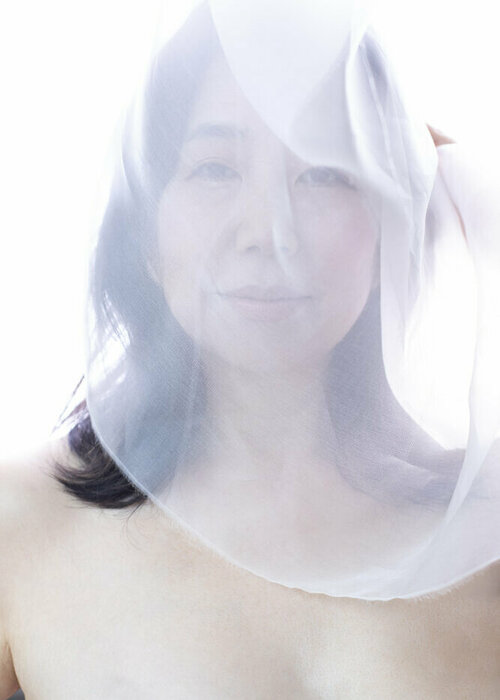
Aomi Kikuchi is an award-winning Japanese textile artist whose works have been exhibited nationally, as well as in the United States and South Korea. Her art is based on Japanese aesthetics and Buddha’s philosophy, which can be summarized in three central concepts: impermanence, insubstantiality, and suffering. Mesmerized by the beauty of Yuzen dyeing, a traditional Japanese dyeing technique for kimonos, Kikuchi devoted nearly three decades to learning the ten stages of its process, which she incorporates in her art.