Not currently available for saleThis piece is currently reserved (either by a client or for an exhibition...).Get notified when it becomes available again.
Thank you very much for your interest!
Your message has been sent successfully! We will get back to you if the artwork becomes available again.
Singulart guarantees reliability and traceability.
All the artists on the platform have been specially selected and certify to only sell works, of which they are the artist. Whatever the medium, the work is sent to the buyer with a certificate of authenticity. Photographs are numbered and signed.
Every customer can be given a copy of their certificate of authenticity by contacting support@singulart.com
With Singulart, you can pay safely by credit card or bank transfer.
For all transactions exceeding your credit limit, contact us. We are required to verify every transfer, as part of the fight against fraud and money laundering.
Singulart prices include:
Price of an artwork defined by an artist.
Insurance. Your order is 100% protected in case of any damage or loss.
All customs fees, taxes, and document preparation.
Third-party logistic provider shipping costs.
A dedicated Singulart customer care specialist that will assist you with any questions or problems during shipment.
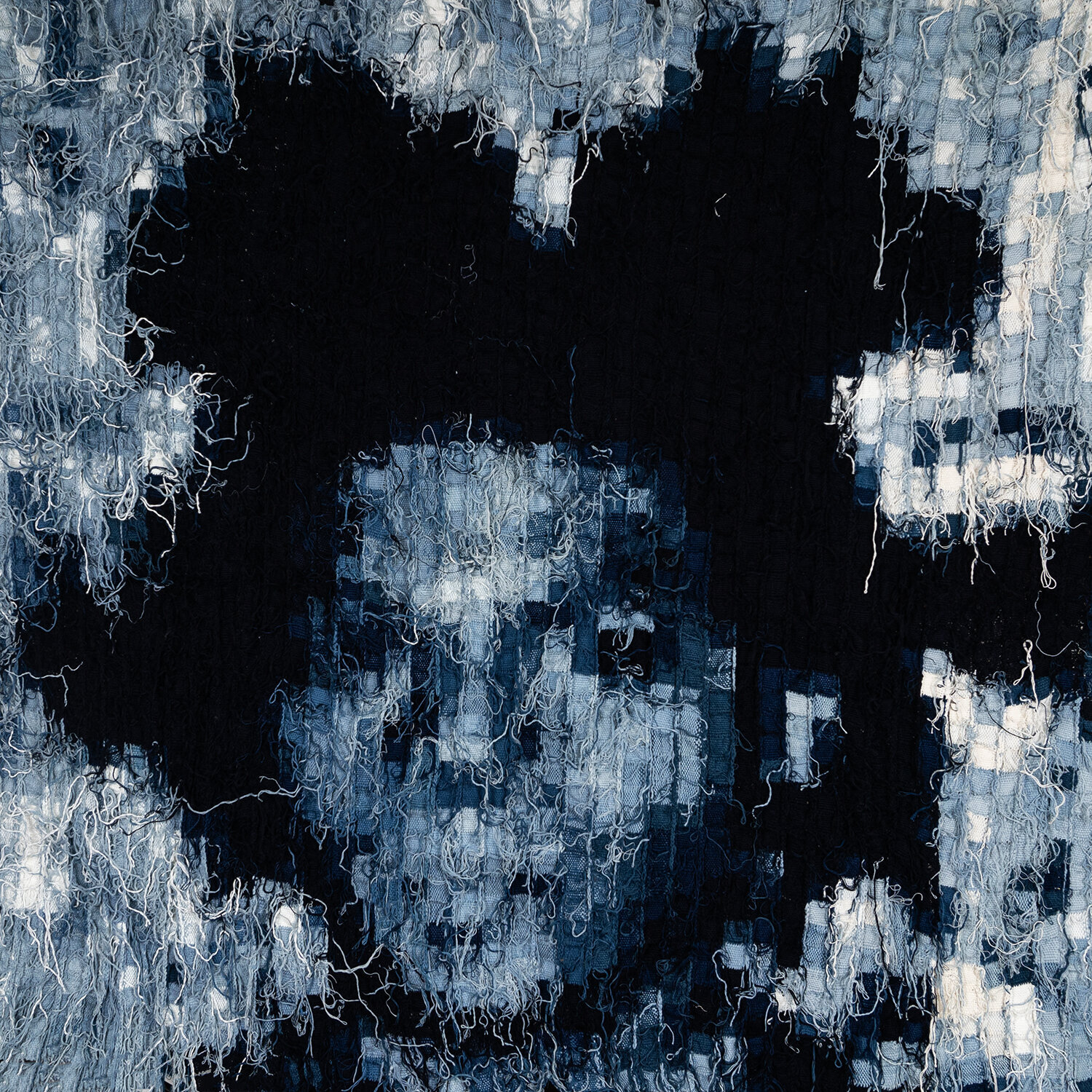
Pixel weaving is a process in which squares called pixels, which are the components of digital photos, are woven together one by one, like developing a photo. Each pixel is a small piece of woven fabric measuring 3cm square. The work I recently completed is based on Basquiat's portrait. I received unused thread from the studio of Yoshida, a craftsman who has been teaching weaving in Nishijin, Kyoto for a long time, and dyed it with indigo, from dark… to light colors, while considering the shades of the pixels. I used threads of various thicknesses by adjusting the number of thread bundles.
The pixel weaving motif of Basquiat represents the transience of our lives. He was able to leave a big mark on art history in his all-too-short life, but I think he wanted to live longer and move his art forward. No one can predict for sure when their life will end, so we should live each and every day to the fullest.
« I am an artist who earnestly learns various knowledge and techniques of textiles, digests them, and takes a unique approach to conventional thinking and methods to create innovative works. »

Aomi Kikuchi is an award-winning Japanese textile artist whose works have been exhibited nationally, as well as in the United States and South Korea. Her art is based on Japanese aesthetics and Buddha’s philosophy, which can be summarized in three central concepts: impermanence, insubstantiality, and suffering. Mesmerized by the beauty of Yuzen dyeing, a traditional Japanese dyeing technique for kimonos, Kikuchi devoted nearly three decades to learning the ten stages of its process, which she incorporates in her art.